
Free Workout Plan Generator
Create a realistic weekly workout plan built around your goal, fitness level, training days, session length, equipment, and limitations. Generate workouts with exercises, sets, reps, rest times, warm-ups, substitutions, and simple progression guidance.
Workout Plan
Your personalized workout plan will appear here...
How the AI Workout Plan Generator Works
Get results in seconds with a simple workflow.
Choose Your Goal and Schedule
Select your primary goal (muscle gain, strength, fat loss, or fitness), your experience level, and how many days per week you can train.
Add Equipment and Constraints (Optional)
Tell us what equipment you have and any limitations. The generator adapts exercise selection and offers substitutions to keep your workouts safe and effective.
Generate, Track, and Progress
Get a complete weekly plan with sets/reps/rest and progression rules. Track your lifts, increase reps or load over time, and adjust based on recovery.
See It in Action
See how the tool turns a vague fitness goal into a structured, actionable weekly workout plan with progression.
I want to get stronger and build some muscle. I can work out 3 days a week and have dumbbells. Not sure what exercises to do.
Goal: Strength + Hypertrophy (3 days/week, dumbbells)
Week Schedule: Day 1 — Full Body (Strength Emphasis) Warm-up: 5–7 min brisk walk + dynamic hips/shoulders
- Goblet Squat — 4 sets x 6–10 reps, rest 90–120s
- Dumbbell Bench Press — 4 x 6–10, rest 90–120s
- One-Arm Dumbbell Row — 4 x 8–12/side, rest 75–90s
- Romanian Deadlift (DB) — 3 x 8–12, rest 90s
- Plank — 3 x 30–60s
Day 2 — Upper/Lower Mix (Volume)
- Split Squat — 3 x 8–12/side
- Overhead Press (DB) — 3 x 8–12
- Lat Pulldown/Band Pulldown — 3 x 10–15
- Hip Thrust (DB) — 3 x 10–15
- Curl + Triceps Extension — 2–3 x 10–15 each
Day 3 — Full Body (Hypertrophy Emphasis)
- Front-Foot Elevated Lunge — 3 x 10–12/side
- Incline DB Press — 3 x 8–12
- Chest-Supported Row — 3 x 10–15
- Lateral Raise — 3 x 12–20
- Dead Bug — 3 x 8–12/side
Progression (8 weeks):
- Add 1 rep per set each week until top of range, then increase weight by 1–2kg per dumbbell and restart at low end.
- Deload on week 5 if performance stalls (reduce sets by ~30%).
Why Use Our AI Workout Plan Generator?
Powered by the latest AI to deliver fast, accurate results.
Personalized Weekly Training Split
Generates a structured workout schedule based on your goal, fitness level, and days per week—so you get a realistic plan you can follow consistently.
Exercises + Sets, Reps, Rest, and Tempo Guidance
Includes key programming details like sets, reps, rest periods, and optional tempo cues to improve training quality, hypertrophy stimulus, and strength progression.
Equipment-Based Programming + Substitutions
Adapts the plan for your available equipment (home workouts, dumbbells, barbell, machines) and provides alternatives to keep training effective anywhere.
Beginner to Advanced Progression Built In
Adds simple progressive overload rules (double progression, load increases, deload guidance) so your workout plan evolves as you get stronger and fitter.
Warm-Up, Mobility, and Recovery Recommendations
Includes quick warm-up templates, mobility suggestions, and recovery tips to reduce injury risk and improve performance across the training week.
Pro Tips for Better Results
Get the most out of the AI Workout Plan Generator with these expert tips.
Use progressive overload (but keep it simple)
Aim to add 1–2 reps per set until you hit the top of the rep range, then increase load slightly. This builds strength and muscle without constant program hopping.
Prioritize good form over heavier weight
Controlled technique and full range of motion improve muscle stimulus and reduce injury risk—especially for squats, hinges, presses, and pulls.
Keep 1–3 reps in reserve for most sets
Training near failure can work, but leaving a small buffer (RIR) supports recovery and consistency—key for long-term progress.
Track a few key metrics
Log loads/reps, body measurements (or photos), and energy/sleep. Small weekly improvements compound into major results over 8–12 weeks.
If time is tight, don’t skip the basics
Focus on big movement patterns (squat/hinge/push/pull/carry/core). Accessory work is helpful, but consistency on fundamentals drives most results.
Who Is This For?
Trusted by millions of students, writers, and professionals worldwide.
Generate a Workout Plan You Can Actually Follow
A workout plan generator works best when it builds around your real life: your goal, training days, session length, equipment, experience, and limitations. Without those inputs, you usually get a list of exercises that looks fine but falls apart after a week.
Use this Workout Plan Generator to create a weekly routine with exercises, sets, reps, rest times, warm-up notes, substitutions, and progression guidance. Treat the output as a practical starting plan, then review it the way you would review any training program.
What to Enter Before You Generate
Be specific where it matters. The generator does not need your entire fitness history, but it does need enough context to avoid a random routine.
Include:
- your primary goal: muscle gain, strength, fat loss, general fitness, endurance, or mobility
- your true fitness level, not the level you wish you were
- training days per week you can repeat consistently
- session length, including warm-up time
- equipment you actually have access to
- movements that cause discomfort or should be avoided
- one or two focus areas, such as glutes, upper body, core, posture, or conditioning
The most useful input is often the constraint. A 45-minute dumbbell plan for three days per week is easier to follow than a vague plan to get fit.
How to Choose the Right Goal or Mode
Choose strength if you care most about lifting heavier over time. The plan should use more compound lifts, longer rest periods, and lower-to-moderate rep ranges.
Choose hypertrophy if your main goal is muscle growth. Expect more weekly volume, accessory exercises, controlled reps, and a mix of compound and isolation work.
Choose fat loss plus conditioning if you want resistance training with cardio or conditioning that does not wreck recovery. The plan should be time-efficient and repeatable.
Choose beginner-friendly if you are new or returning after time off. The best beginner plan is simple, conservative, and easy to track.
Choose home workout if equipment is limited. The generator can keep the movement pattern while changing the exercise, such as swapping a barbell squat for goblet squats or split squats.
Review the Generated Plan Before You Start
Do not judge the plan by how hard it looks. Judge it by whether you can run it for several weeks.
Check these points:
- Does the weekly split match your actual schedule?
- Are sessions short enough to finish without rushing?
- Do the main lifts fit your equipment and skill level?
- Are there substitutions for exercises you cannot do?
- Is progression clear enough to track?
- Does the plan leave room for recovery?
If something feels unrealistic, edit that input and generate again. For example, change five days to three days, reduce session length, or describe the equipment more precisely.
Example Input and Output Review
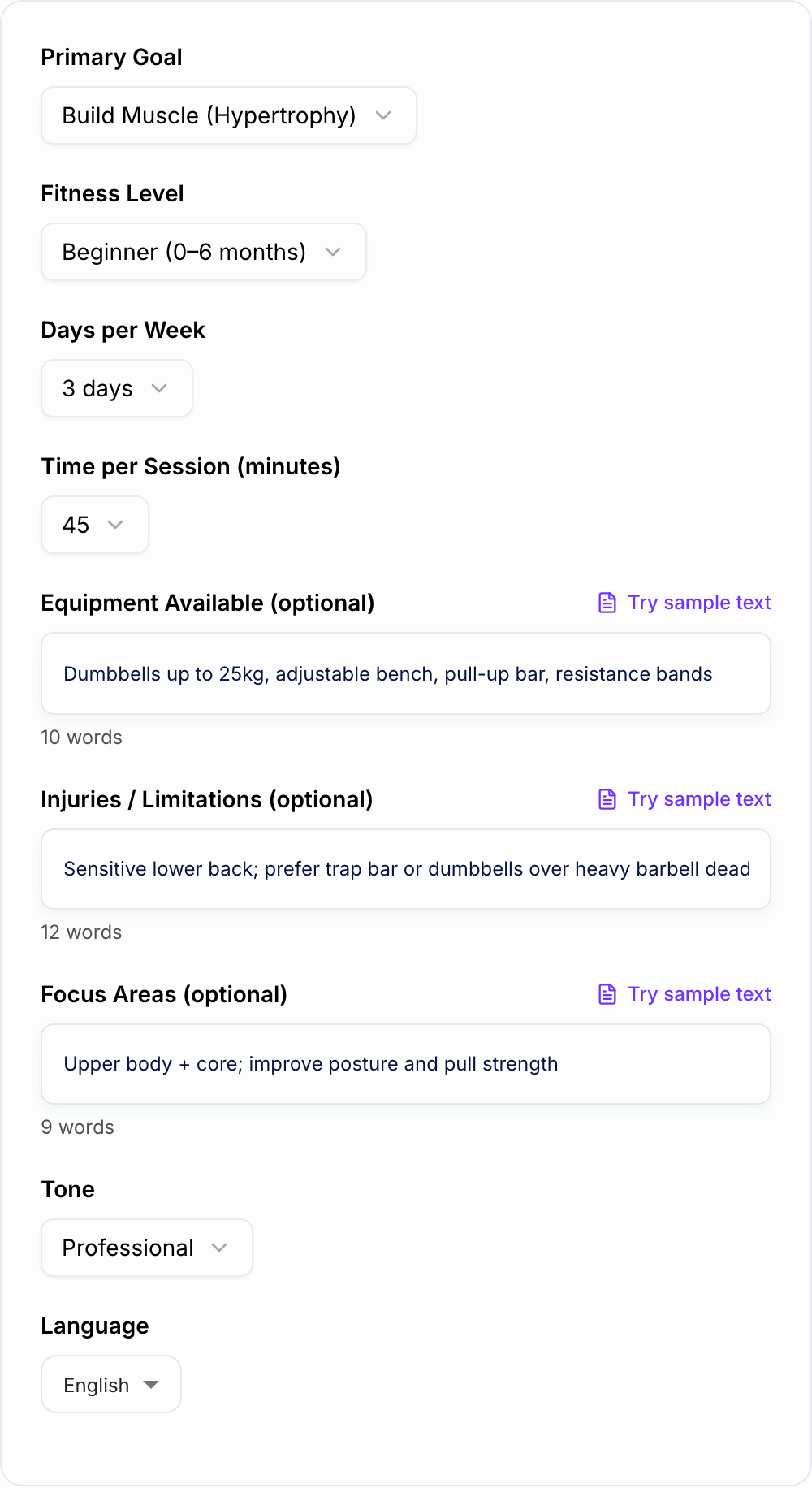
Input: beginner, muscle gain, three days per week, 45 minutes, dumbbells up to 25 kg, bench, bands, sensitive lower back, focus on upper body and core.
A strong generated plan should probably use a full-body or upper-body-emphasis split, supported rows instead of heavy unsupported pulling, dumbbell presses, split squats or goblet squats, core work that does not aggravate the back, and simple rep-based progression.
A weak output would ignore the lower-back note, include too many exercises for 45 minutes, or require equipment you did not list.
How to Use Progression Without Overcomplicating It
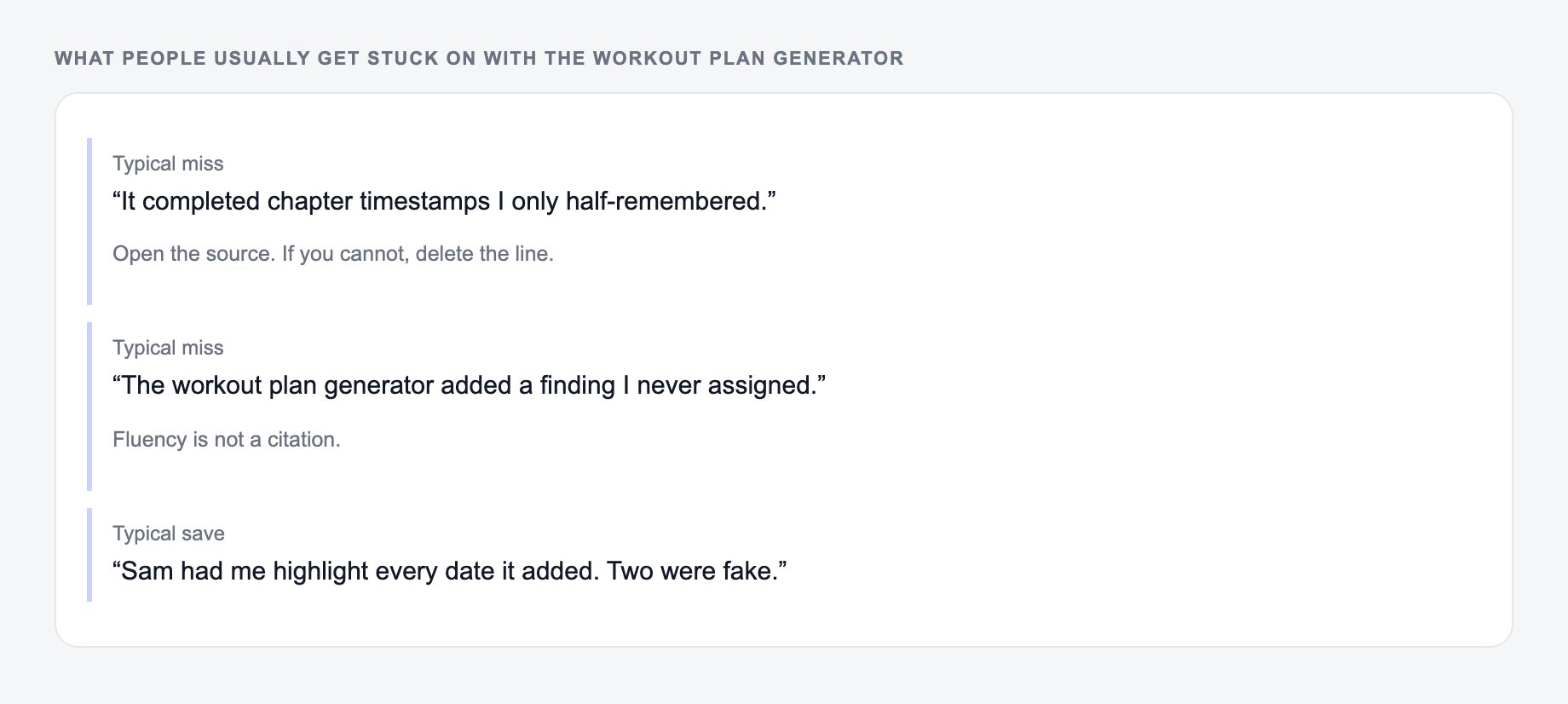
If the output felt generic, it is usually one of these three misses.
The simplest progression rule is enough for many people: stay within a rep range, add reps until you reach the top of the range, then add a small amount of load and start again.
You can also progress by improving control, adding a set, shortening rest slightly, or choosing a harder variation. Do not change everything at once. If every week is a new routine, you cannot tell what is working.
Safety and Common Sense Checks
This tool can help you create a better routine, but it cannot diagnose pain or replace a coach, doctor, or physical therapist. If an exercise causes pain, stop and get qualified guidance. If you have a medical condition, get professional advice before starting a new training plan.
For planning beyond the workout itself, Junia AI can help you create training notes, habit trackers, checklists, and weekly review templates so the plan is easier to follow.
Final Checklist Before Your First Session
Check workout plan generator output against the room you actually have:
- Times, loads, and criteria match what you typed
- Nothing medical, legal, or graded was invented
- You would still own this if a parent or clinician asked
- Training days match your real week.
- Exercises match your equipment.
- Sets and reps are clear.
- Rest times are realistic.
- Warm-up is included.
- Painful movements have substitutions.
- Progression is simple enough to track.
Generate the plan, review it honestly, then run it consistently before changing it again.
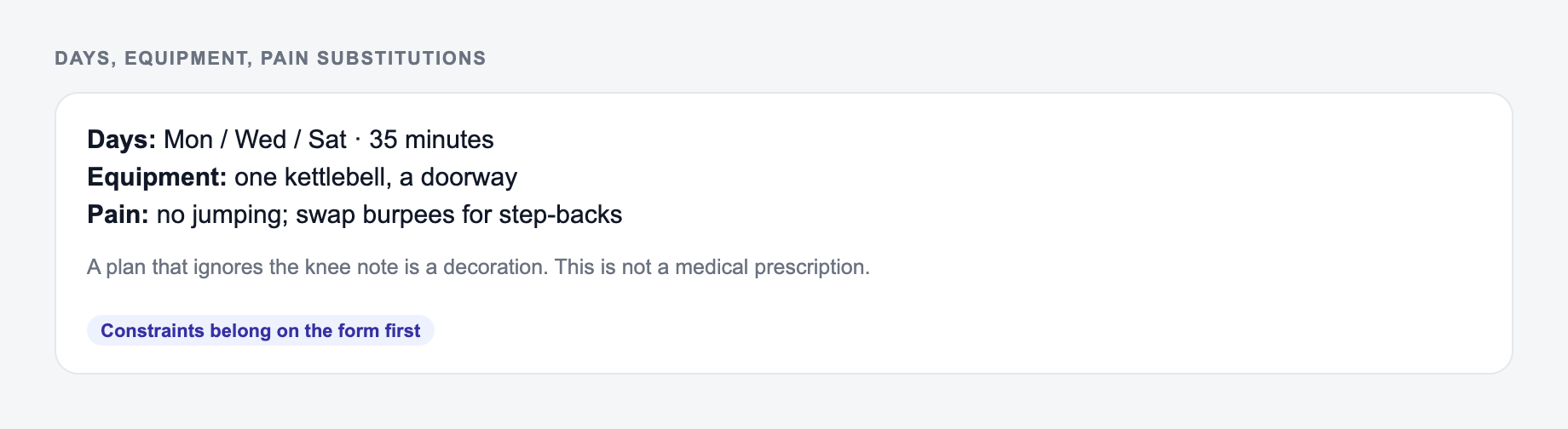
Constraint Match: Days, Equipment, Pain Substitutions
Plans fail when they assume a gym, a fifth training day, or a movement the person cannot do. Before week one, rewrite the plan against constraints, not goals.
If the form still includes an exercise you cannot do, the plan is the wrong plan.
Use the AI Workout Plan Generator to get a shape on the page. Then do the slow part: open the source, check the number, and cut unsourced certainty.
Filled check for a hypothetical beginner: 3 days/week, 40 minutes, dumbbells only, no barbell squats because of knee discomfort.
- If the plan includes barbell back squats, it is the wrong plan—even if the goal field said “build muscle.”
- If rest is 90 seconds but the session would exceed 40 minutes, cut a set or an isolation move.
- Progression should be one variable: add a rep, then a small load, not new exercises every session.
This tool cannot diagnose pain, screen for medical risk, or replace a qualified coach or clinician. Stop with sharp pain. Get professional advice before starting if you have an injury or medical condition. Do not treat generated volume as a prescription.
Frequently Asked Questions
Is this workout plan generator free?+
Yes. You can generate a personalized workout plan for free. Some specialized modes (like athletic performance) may be marked as premium depending on your site settings.
Can it generate a workout plan for home with minimal equipment?+
Yes. Add your available equipment (or leave it blank and specify “bodyweight only”) and the plan will use home-friendly exercises plus substitutions and progressions.
Will the plan include sets, reps, and rest times?+
Yes. The output includes sets, reps, rest periods, and simple progression rules so you know exactly what to do each session and how to improve week to week.
How do I choose the best training split (full body vs upper/lower)?+
The generator selects a split based on days per week and your goal. For 2–3 days, full-body is often ideal. For 4+ days, upper/lower or push/pull/legs commonly works well.
Can this replace a coach or physical therapist?+
No. This tool provides general fitness programming. If you have injuries, medical conditions, or pain during training, consult a qualified coach or healthcare professional.
How long should I follow the plan before changing it?+
Most people benefit from running a plan for 6–12 weeks, tracking performance, and then updating exercise variations, volume, or goals based on progress and recovery.