
Free Humanizer
Rewrite stiff, robotic, or overly polished AI text into natural human-sounding copy while preserving the original meaning. Choose tone, readability, language, and keywords to improve blog posts, emails, SEO content, LinkedIn posts, product copy, and business writing.
Humanized Text
Your humanized, natural-sounding text will appear here...
Tired of fixing robotic drafts after the fact? With a saved brand voice, Junia writes in your own tone from the first draft.
How the AI Text Humanizer Works
Get results in seconds with a simple workflow.
Paste Your Text
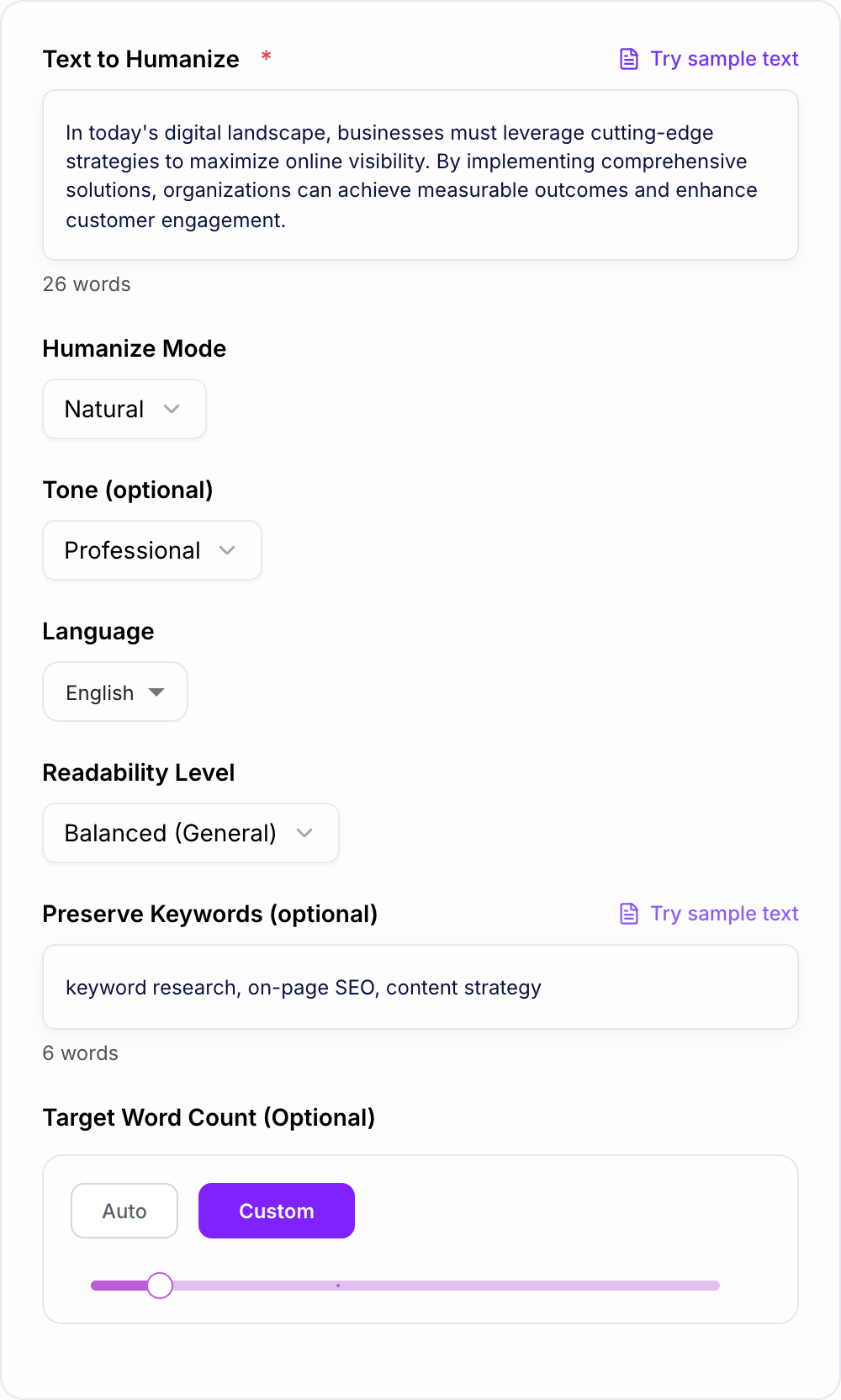
Add your AI-generated draft (or any text). The tool works best on a paragraph or a section at a time to keep voice consistent and meaning intact.
Choose Mode, Tone, and Readability
Select how you want it to sound (Natural, Professional, Simple, Academic). Optionally set readability level and preserve important SEO keywords or brand terms.
Generate and Review
Get a human-sounding rewrite instantly. Copy it, then do a quick final pass to confirm names, numbers, and any compliance-sensitive wording.
See It in Action
Example of humanizing AI-sounding text into a natural, clearer version without changing the meaning.
In today's digital landscape, businesses must leverage cutting-edge strategies to maximize online visibility. By implementing comprehensive solutions, organizations can achieve measurable outcomes and enhance customer engagement.
Online visibility doesn’t improve by accident—you need a clear strategy and consistent execution. When you focus on the right channels and fix the fundamentals (content, technical SEO, and messaging), you can attract more qualified visitors and build stronger engagement over time.
Why Use Our AI Text Humanizer?
Powered by the latest AI to deliver fast, accurate results.
Human-Sounding Rewrites (Less Robotic, More Natural)
Transforms AI-generated wording into natural phrasing with smoother transitions, varied sentence structure, and a more authentic voice—while keeping your original meaning intact.
Meaning-Preserving Editing (No Unwanted Message Changes)
Maintains your core claims, intent, and key details while improving clarity and readability—ideal for refining blog drafts, landing pages, and email sequences without rewriting from scratch.
Tone and Voice Control (Professional, Simple, Academic)
Adjusts the writing style to match your audience and context—polished business writing for clients, simpler explanations for beginners, or formal academic tone for essays and reports.
SEO-Friendly Humanization (Readable, Intent-Aligned)
Improves on-page readability and reduces repetitive phrasing while keeping important keywords natural—helpful for refreshing SEO content, improving engagement, and reducing “AI-sounding” text.
Keyword Preservation (Optional)
Optionally preserve specific SEO keywords, brand terms, and product names so your content stays aligned with search intent and on-page optimization requirements.
Pro Tips for Better Results
Get the most out of the AI Text Humanizer with these expert tips.
Humanize in sections for the most natural voice
For long articles, humanize one section at a time (intro, each H2 block, conclusion). This reduces drift and keeps the writing consistent and readable.
Preserve the keywords that matter (but keep it natural)
List your primary keyword and a few essential terms to preserve. Let the tool rewrite everything else so the content stays intent-aligned without sounding stuffed.
Remove vague marketing filler to improve trust
Phrases like “cutting-edge solutions” and “maximize outcomes” can sound generic. Humanizing helps replace them with specific, credible wording that improves conversions and E-E-A-T signals.
Keep claims accurate—especially numbers and guarantees
Humanizing changes phrasing. Double-check metrics, pricing, medical/legal claims, and guarantees to ensure accuracy and compliance before publishing.
Aim for skimmability if it’s web content
If you’re humanizing SEO copy, prefer shorter sentences and clearer wording. Readability often improves engagement, time on page, and conversion rate.
Who Is This For?
Trusted by millions of students, writers, and professionals worldwide.
Humanize AI Text Without Losing the Meaning
The AI text humanizer rewrites stiff, robotic, or overly polished text into copy that sounds more natural while keeping the original message intact.
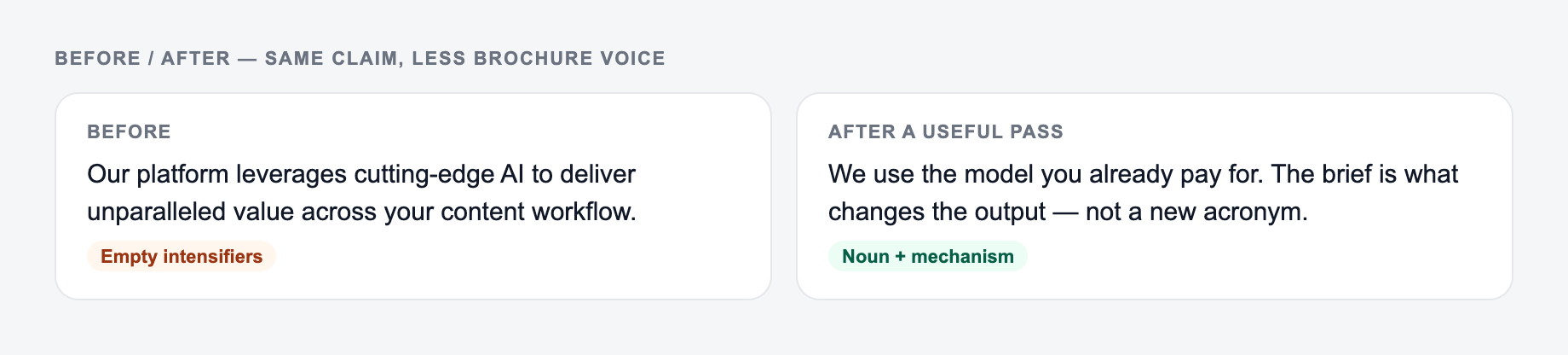
Use it when a draft is factually useful but awkward to read. That often happens with AI-generated blog sections, LinkedIn posts, product descriptions, emails, landing page copy, and SEO content. The ideas may be fine, but the rhythm is repetitive, the transitions feel generic, or the wording sounds like it came from a template.
The humanizer is best used as an editing pass, not a fact-checking tool. It can improve phrasing, flow, tone, and readability. It cannot verify claims, add real experience, or decide whether the argument is strong.
What to Paste Into the Humanizer
You can paste a full draft, but the strongest results usually come from working section by section.
Good inputs include:
- one blog introduction
- one H2 section
- an email draft
- a product description
- a landing page hero section
- a LinkedIn post
- a short academic paragraph
- a support reply or client message
If the text includes required terms, add them to the keyword preservation field. This is useful for SEO keywords, product names, brand terms, technical phrases, and names that should not be changed.
Do not preserve every possible phrase. Too many locked terms can make the output sound stiff again.
How to Choose the Right Humanize Mode
Use Natural when you want the safest default for web copy, blog content, social posts, and general rewriting.
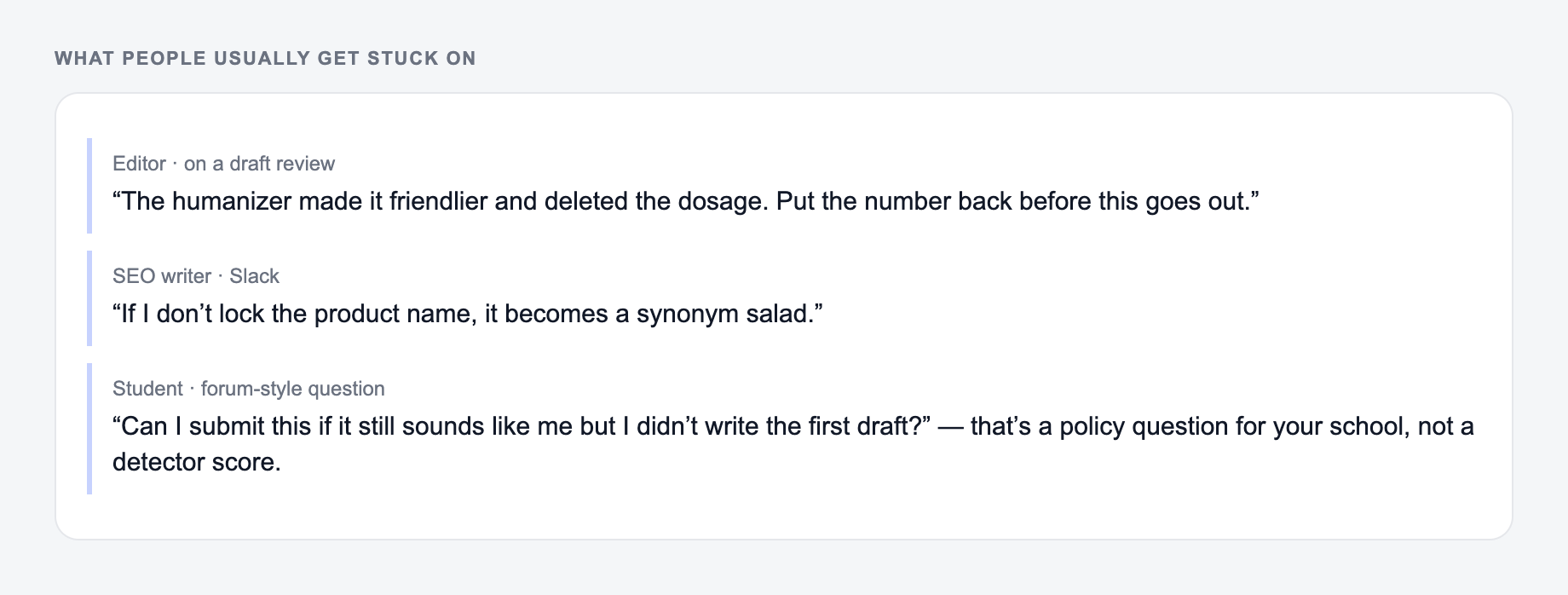
Use Professional for proposals, client messages, internal updates, business emails, reports, and sales copy that needs to sound polished but not inflated.
Use Simple when the source text is dense, full of jargon, or aimed at a broader audience. This mode is useful for readability cleanup.
Use Academic for formal essays, research-style paragraphs, and writing that needs a more precise tone.
Use SEO-Friendly when the draft needs smoother readability while keeping search intent and important keywords natural.
Use Brand Voice Match when consistency matters across a campaign, site, or client account. For best results, paste a short style sample labeled "Style reference" at the end of your input.
Example: Robotic Text to Humanized Copy
Input:
In today's digital landscape, businesses must leverage cutting-edge strategies to maximize online visibility. By implementing comprehensive solutions, organizations can achieve measurable outcomes and enhance customer engagement.
Humanized output:
Online visibility does not improve by accident. Businesses need a clear strategy, useful content, and consistent execution. When those pieces work together, it becomes easier to attract the right visitors and keep them engaged.
The improved version keeps the original meaning, but removes vague filler like "leverage," "cutting-edge," and "comprehensive solutions." It also uses a cleaner rhythm. That pair is the job of the form: paste the stiff section, lock any terms you cannot change, and pick a mode.
Annotation pass after you generate:
-
Highlight anything the rewrite added. If you cannot source it, cut it.
-
Highlight anything it deleted. If it was a condition, put it back.
-
Read the before and after aloud. If the after sounds friendlier but vaguer, it failed.
-
Original pattern: “In today’s digital landscape…” · After a useful humanize pass: A specific opening · Not a success: A new statistic you did not provide
-
Original pattern: “leverage / comprehensive” · After a useful humanize pass: Concrete verbs · Not a success: Softer claims that change the promise
-
Original pattern: Even, templated rhythm · After a useful humanize pass: Mixed sentence length · Not a success: First-person experience the source never had
How to Review Humanized Output
After generating the rewrite, check four things.
First, confirm the meaning stayed the same. A smoother sentence is not useful if it changes the claim.
Second, check facts and names. The tool may preserve wording well, but you still need to verify numbers, dates, product details, legal wording, medical claims, and anything compliance-sensitive.
Third, look for over-softening. Sometimes a rewrite becomes too polite or too general. Put back any sharp, specific phrasing that matters.
Fourth, read it out loud. If the copy still sounds too perfect, repetitive, or corporate, run a shorter section through the humanizer again with a clearer tone.
Humanizing vs Paraphrasing
Paraphrasing changes wording. Humanizing changes the reading experience.
A paraphrase may simply replace words with near-synonyms. A humanized rewrite should improve rhythm, clarity, emphasis, transitions, and sentence variety. It should also remove AI-sounding patterns such as repeated openers, generic claims, and overly balanced paragraphs that never take a clear stance.
If the draft needs deeper structure, use an AI text editor before the humanizer. If the draft came from an AI text generator, use the humanizer as the final voice and readability pass.
SEO Workflow for Humanized Content
Humanized text can support SEO when it makes a page clearer and easier to read. It does not rank content by itself.
For SEO content, use this workflow:
- Paste one section at a time.
- Preserve the primary keyword and any must-keep terms.
- Choose SEO-Friendly or Natural mode.
- Review the rewrite for search intent and factual accuracy.
- Add specific examples, product details, or experience where the draft feels generic.
- Use a readability pass if the section is still dense.
For a more complete workflow, you can review guidance on how to humanize AI text, compare humanized AI text examples, and use a readability improver before publishing. An AI text detector can be useful as a rough diagnostic, but it should not replace editorial judgment.
Common Humanizer Mistakes
The first mistake is expecting the tool to fix weak thinking. If the original draft has vague claims, missing examples, or inaccurate details, humanizing will only make the weakness easier to read.
The second mistake is processing too much text at once. Long inputs can drift in tone. Section-level rewriting gives you more control.
The third mistake is preserving too many keywords. Keep the phrases that truly matter and let the surrounding language breathe.
The fourth mistake is skipping the final review. The humanizer can improve voice, but you are still responsible for accuracy and fit.
The fifth mistake is trying to make every sentence casual. Human-sounding writing can still be formal, technical, or academic when the context calls for it.
Final Humanized Text Checklist
Before you publish or send the rewritten text, check that:
- the meaning is unchanged
- facts, names, numbers, and claims are accurate
- required keywords or brand terms remain intact
- the tone fits the audience
- the sentence rhythm feels varied
- the copy is easier to skim
- no important detail was softened or removed
The best use of a humanizer is simple: let it remove the robotic layer, then add your own judgment where the text needs accuracy, specificity, and taste.
An Editorial A/B Review That Does Not Rely on Detector Scores
Prepare two short drafts with different problems: one full of generic transitions and one technically accurate but monotonous. Humanize each in Natural and Professional modes. Blind-label the outputs, then ask an editor to mark vague language, meaning drift, sentence-pattern repetition, and any sentence that implies experience not present in the source. An AI-detector score is not evidence of quality or authorship.
Brand Voice
Make every article sound like you
- Save your tone, terminology, and style once
- Junia applies it to every piece it writes
- No more fixing robotic drafts after the fact
Frequently Asked Questions
What does a humanizer do?+
A humanizer rewrites text to sound more natural, fluent, and human—reducing robotic phrasing and repetition while preserving the original meaning. It’s commonly used to refine AI-generated drafts for blogs, SEO pages, emails, and social posts.
Will this change the meaning of my text?+
The goal is meaning-preserving rewriting. The tool keeps your intent, key points, and factual claims the same while improving clarity, flow, and tone. Always review the output for domain-specific nuances.
Can I humanize SEO content without losing keywords?+
Yes. Use the keyword preservation field to keep important target keywords, brand terms, or product names. The rewrite will keep them naturally integrated without keyword stuffing.
Is this the same as paraphrasing?+
Humanizing overlaps with paraphrasing, but it focuses more on naturalness, readability, and authentic voice. Instead of just swapping words, it improves rhythm, sentence variety, and clarity so the text reads like a human wrote it.
Can I use it for academic writing?+
Yes. Choose Academic mode for a more formal, precise style. It will reduce overly salesy language, tighten structure, and improve clarity while keeping the original meaning.
How do I make the output sound like my brand voice?+
Pick a specific tone and provide any key terms to preserve. For best results, paste a short sample of your preferred style at the end of your input text (labeled “Style reference”) so the rewrite can match your cadence and wording preferences.